

Integrated services can bring cleaning, security, maintenance and customer experience together under one provider. But the real value comes from what happens when those teams start to think and operate as one.
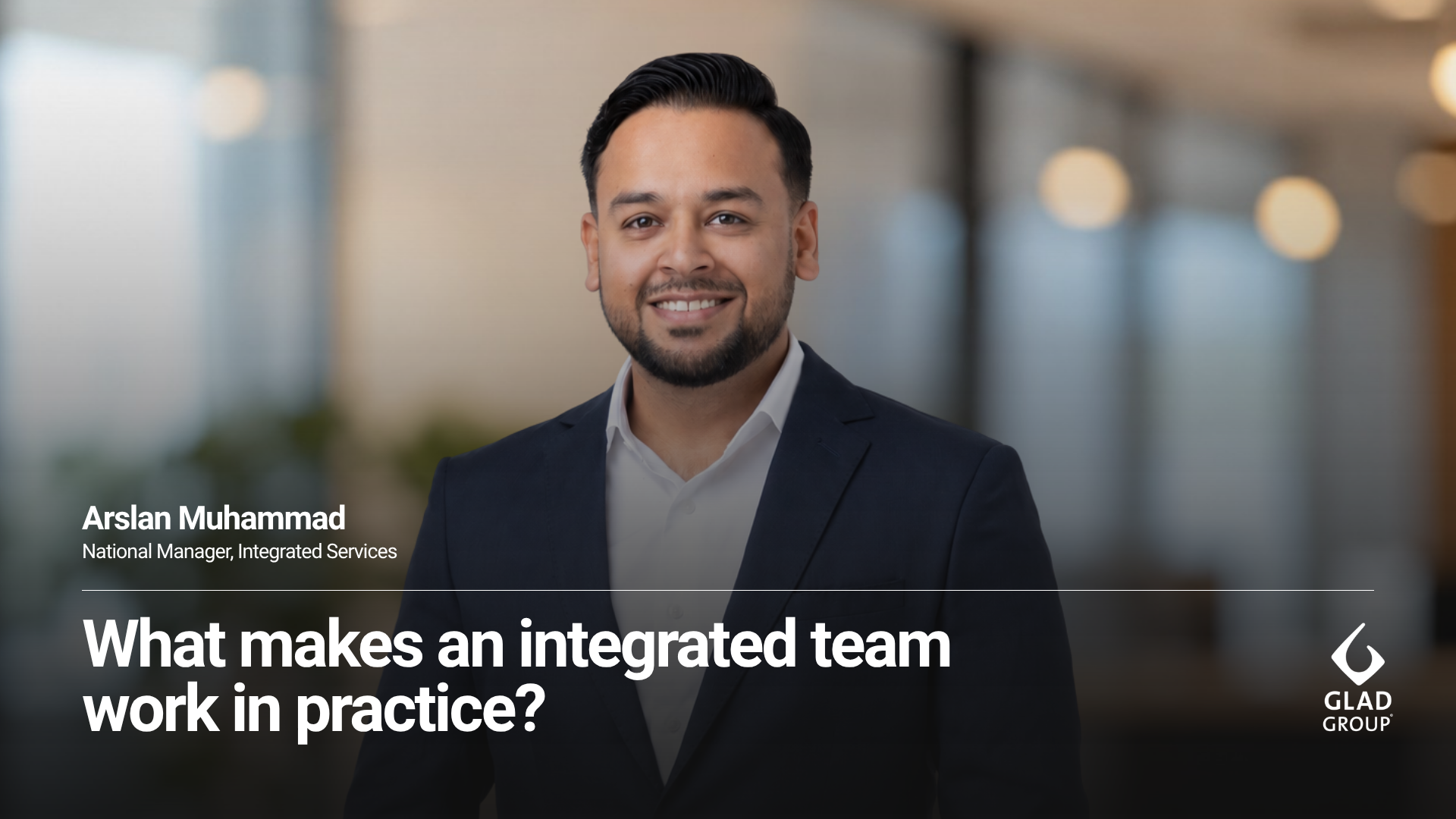
For Arslan Muhammad, National Manager – Integrated Services at Glad Group, that means creating a site culture where people understand their own responsibilities, while also keeping an eye on the bigger picture.
“For me, Integrated Services is ultimately about creating an environment where great people work together as one team to make the site operation better.”
We spoke with Arslan about what integration looks like in practice, why communication and culture matter, and how connected teams can create a more responsive operation for clients.
Everyone is looking out for the asset
The value of an integrated model isn’t that everyone suddenly does everyone else’s job.
Cleaning, security, maintenance and customer experience remain specialist disciplines, each with their own responsibilities and expertise.
The difference is awareness.
On an integrated site, team members are encouraged to look beyond the immediate boundaries of their role and understand how what they see can affect the wider operation.
A cleaner might notice a maintenance issue while moving through the site. A maintenance team member might spot unusual activity while completing their checks. Security might identify a hazard that requires another team’s attention.
Those observations can then be shared quickly with the people best placed to respond.
For Arslan, these everyday interactions are where integration becomes tangible.
“These may seem like small things, but collectively they create a team that is more aware, more responsive and less dependent on traditional service boundaries.”
One team focused on the same outcome
That broader awareness becomes particularly valuable when conditions change quickly.
Arslan recalls a busy trading day when a site’s car park was approaching capacity. Rather than each team remaining focused solely on its individual responsibilities, Glad Group team members worked alongside the car park team to support the operation and help keep the customer experience moving.
For the client, the distinction between individual service streams mattered less than the outcome.
There was one team responding to what the asset needed at that moment.
“When cleaning, security, maintenance and concierge work as one connected operation, information moves faster, issues are resolved earlier and resources can be deployed where they’re needed most,” Arslan says.
That ability to respond collectively is an important part of the integrated model. It gives teams greater flexibility while reducing the need for the client to coordinate individual providers or determine where responsibility sits.
Communication can change the outcome
When asked what can never go wrong on a busy day, Arslan’s answer is immediate: communication.
Every service stream moves through a site differently and sees different parts of the operation.
The value comes from connecting those observations.
“When information is shared quickly, teams can anticipate what’s coming, support each other and streamline the operation rather than reacting independently.”
A recent food court incident demonstrates the point.
A member of the cleaning team noticed that something didn’t look right with part of the ceiling and alerted the security team. The area was secured and maintenance was engaged before ceiling panels came down.
The individual roles remained clear, but information moved quickly between them.
The cleaner didn’t need to diagnose a maintenance problem. They simply needed the awareness to recognise that something looked wrong, the confidence to speak up and a team around them that knew how to respond.
Building a One Team, One Community culture
For Arslan, creating that kind of response requires more than putting different service teams under the same organisational structure.
It depends on culture.
Glad Group describes the approach as One Team, One Community – creating an environment where people understand how their role contributes to the wider site and are encouraged to support the collective outcome.
“We encourage our people to look beyond their individual roles, understand the bigger picture and develop skills outside their core responsibilities,” Arslan says.
Leadership and training are important parts of that.
Teams need the confidence to communicate, escalate issues and make decisions when conditions change. They also need leaders who understand the operation and can bring different service streams together.
Arslan also sees internal development as an important part of building that culture.
Visible opportunities for progression give people a reason to broaden their understanding of the operation, develop new capabilities and see a longer-term future within the organisation.
Integration is ultimately about people
Technology, reporting and systems all have an important role in integrated service delivery. But for Arslan, the model ultimately comes back to people.
People who notice.
People who communicate.
People who understand that what happens outside their immediate service stream can still affect the experience of the client, customer or asset.
“For me, true integration is when people stop asking, ‘Is this my job?’ and start asking, ‘What can I do to make our team and our customer experience better?’”
That mindset is what turns multiple service streams into one connected operation – and gives clients a team that is looking out for the whole asset, not simply one part of it.
Discover what an integrated approach could look like for your organisation.
Add a Comment